

If you started Accutane and noticed more hair in your drain or on your brush, you are not imagining things. Hair loss is a documented side effect of isotretinoin, the active ingredient in Accutane, and it is one that many dermatologists do not discuss in detail before treatment begins.
The good news is that for most patients, it is temporary. Here is what you need to know.

Why Does Accutane Cause Hair Loss?
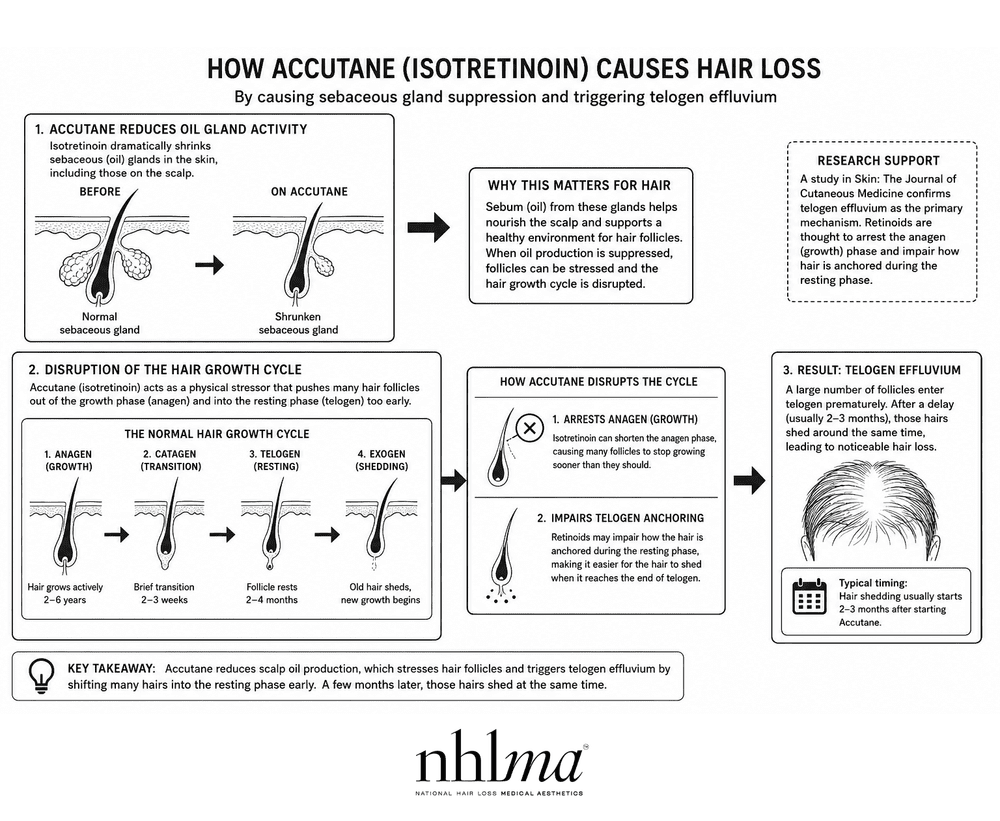
Accutane works by dramatically reducing oil gland activity in the skin. This is what makes it so effective for severe acne, but those same oil glands in your scalp play a role in keeping your follicles healthy. When isotretinoin suppresses them, it can disrupt the hair growth cycle in two key ways.
The most common is telogen effluvium. This is when a physical stressor, in this case the medication, causes a large number of follicles to shift prematurely into the resting phase. A few months later, those follicles shed at the same time, which is when you notice increased hair fall. Research published in Skin: The Journal of Cutaneous Medicine confirms telogen effluvium as the primary mechanism, with retinoids thought to arrest the anagen (growth) phase and impair how hair is anchored during the resting phase.
Beyond that, a 2018 study in the Journal of the European Academy of Dermatology and Venereology found that isotretinoin directly affects the hair cycle at a cellular level, further supporting the link between the drug and follicle disruption.
How Common Is It?
Less common than most people fear. A systematic review of 22 studies published in the Journal of the American Academy of Dermatology found that hair loss occurred in about 3.2% of patients on lower doses and 5.7% of patients on higher doses.
That said, these numbers likely reflect clinically documented cases. Milder shedding that patients manage at home probably goes underreported. A separate retrospective study found that patients who did experience hair loss tended to be older, had higher cumulative doses, and had been on treatment for longer.
The takeaway is that dose matters. If hair loss is a concern for you, it is worth talking to your prescribing doctor about whether your dose can be adjusted.
What Does It Look and Feel Like?
Accutane-related hair loss is usually diffuse, meaning it affects the whole scalp rather than specific patches or a receding hairline. You may notice your ponytail feels thinner, more hair on your pillow, or increased shedding when washing. The scalp may also feel drier or more sensitive than usual.
Shedding typically begins two to four months after starting treatment, though some patients do not notice it until they are finishing their course.
Before & After of Patient with Telogen Effluvium – Her hair growth protocol involved 6 Months of Minoxidil, Lasers, and Exosomes


Will It Grow Back?
For most people, yes. Once the medication is stopped and the follicles complete their resting phase, hair typically begins regrowing within a few months. Most patients see noticeable improvement within six to twelve months of finishing treatment. Recovery can be slower if nutritional deficiencies developed during the course, or if Accutane has unmasked an underlying pattern hair loss that was previously subclinical. If you are still experiencing significant shedding three to six months after stopping Accutane, that is a signal to get a proper evaluation rather than continuing to wait.
What Can You Do During Treatment?
You do not have to simply ride it out because a few things can meaningfully support your scalp while on Accutane.
-
Because isotretinoin dries out your oil glands, your scalp will likely be drier than usual. Switch to a gentle, sulfate-free shampoo and consider a lightweight scalp serum or oil to maintain the skin barrier. Be gentle with your hair overall: avoid tight styles, aggressive brushing, and heat where possible. Shop our shampoos and scalp serums here.
-
Nutrition matters too. Iron, ferritin, zinc, and B vitamins are all critical for follicle health and are worth checking via bloodwork before or early in your course. Addressing any deficiencies proactively gives your follicles the best chance of staying in the growth phase. Shop our supplements here.
-
In-clinic options like low-level laser therapy can also help support the follicle environment during treatment, which is something we discuss with patients who are concerned. Shop our bestselling laser hair cap here.


When to See a Specialist
Most Accutane-related shedding is manageable and resolves on its own. But we recommend a hair specialist evaluation if your shedding is severe or rapid, if you notice patterned thinning rather than diffuse shedding, if your hair has not started recovering six months after stopping treatment, or if you had existing hair thinning before starting Accutane.
A proper evaluation looks at your scalp health, your comprehensive labs, and your full history. Sometimes a concurrent issue like thyroid imbalance, low ferritin, or early androgenetic alopecia is contributing, and identifying that early makes a real difference in outcomes.
How NHLMA Can Help
At NHLMA, we work with patients at every stage: before starting Accutane to establish a baseline, during treatment if you are noticing changes, and after to support recovery. Our approach starts with a thorough evaluation before recommending anything, and our treatment options range from nutritional support and scalp therapy to exosomes and low-level laser, depending on what we find.
You do not have to choose between clear skin and healthy hair. With the right support, most patients complete their Accutane course and come out the other side with both.
If you’re interested in learning more about your hair health or exploring hair restoration options, schedule a complimentary evaluation with one of our hair loss specialists today. Take the first step towards restoring your confidence and embracing your best self.