

If you have been researching options for female pattern hair loss, you have probably come across finasteride. You may know it by the brand name Propecia. You may have seen it mentioned on forums, heard it from a friend, or had a provider bring it up as a possibility. And you may have been left with more questions than answers about whether it is actually appropriate for women.
That confusion is understandable. The story of finasteride and female hair loss is more nuanced than most sources make it sound, and it deserves a straightforward answer.
Propecia vs. Finasteride: What Is the Difference?
First, a quick clarification that trips a lot of people up. Finasteride is the drug. Propecia is just a brand name for finasteride at a specific dose: 1 milligram per day, packaged and marketed for men with androgenetic alopecia (male pattern hair loss). There is also a 5mg version called Proscar, originally developed for enlarged prostate.
When women are prescribed finasteride, it is always off-label, meaning the FDA has not approved it for female hair loss. The dose women are typically given is higher than the Propecia dose: usually 2.5 to 5mg per day rather than 1mg. This distinction matters when you are evaluating the evidence, because most of the studies showing limited effectiveness in women were done at the lower 1mg dose.
How Finasteride Works
Finasteride works by blocking an enzyme called 5-alpha reductase, which converts testosterone into dihydrotestosterone (DHT). DHT is the hormone most associated with miniaturizing hair follicles in both men and women with pattern hair loss.
In men, DHT is produced primarily in one place, which makes blocking its conversion relatively straightforward. In women, DHT production happens through multiple pathways simultaneously, which is one reason why the hormonal picture is more complex and why a one-size-fits-all approach to blocking it does not always work as cleanly.
This complexity is also why female hair loss often requires a more layered evaluation before any hormonal intervention is considered.
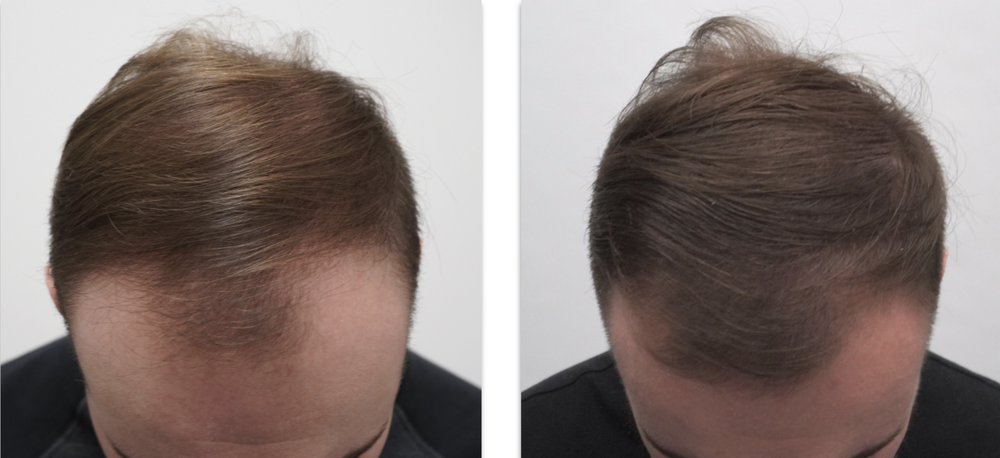
An NHLMA Patient who used Propecia, Medical Grade Laser, and a Compounded Topical RX Formula for 1 Year

Does Finasteride Actually Work for Women?
Here is where the story gets more interesting than the simple “not approved for women, therefore not effective” framing you often see.
The original clinical trials that led to Propecia’s approval for men also tested 1mg finasteride in postmenopausal women with female pattern hair loss. Those trials showed no significant improvement over placebo, which is why finasteride is not FDA-approved for women.
But research at higher doses tells a different story.
A study published in PubMed following 112 women with female pattern hair loss treated with 2.5mg per day found that 65.2% showed significant improvement and 29.5% showed slight improvement, with only 5.4% showing no change. That is a meaningful response in a real patient population.
A meta-analysis published in PMC reviewed available studies and found an overall response rate of 81% in women treated with finasteride, with the higher dose group (2.5mg and above) showing an 86% response rate compared to 70% in the lower dose group.
A separate review of finasteride’s potential for female hair loss concluded that it can produce meaningful results in the right patient, particularly in postmenopausal women, and that the dose matters significantly.
The honest summary: the original 1mg trials were underwhelming, but higher-dose finasteride used appropriately in the right patient shows real promise. The evidence is stronger than the “not for women” label suggests, particularly at doses above what Propecia provides.


Who Is and Is Not a Candidate
This is the most important part of the conversation, and it is why finasteride for women should always involve a thorough consultation rather than a quick prescription.
Women who cannot take finasteride include anyone who is pregnant, trying to become pregnant, or not using reliable contraception. Finasteride can cause serious birth defects in male fetuses, and even skin contact with broken or crushed tablets carries a risk. This is a firm contraindication, not a preference. Premenopausal women who are prescribed finasteride off-label must be using reliable birth control and must be counseled clearly on this risk.
Women who may be appropriate candidates include postmenopausal women with female pattern hair loss, premenopausal women who are not and do not intend to become pregnant and who are using reliable contraception, and women who have not responded adequately to first-line treatments like minoxidil.
Even for appropriate candidates, finasteride is not the right choice for everyone. Hormonal context matters, the underlying cause of the hair loss matters, and whether other factors like thyroid function or iron levels have been addressed first matters. This is why we do not prescribe it in isolation at NHLMA.
What Are the Alternatives?
Whether finasteride is right for you or not, there are several other treatments with strong evidence for female pattern hair loss worth knowing about.
-
Topical minoxidilis the most established FDA-approved treatment for women with pattern hair loss. It works differently from finasteride, stimulating follicle activity rather than addressing DHT, and it is appropriate for a much broader range of patients including premenopausal women.
-
Low-level laser therapy (LLLT)uses specific wavelengths of light to stimulate follicle metabolism and is a well-tolerated, non-hormonal option that works well as part of a combined protocol.
-
PRP (platelet-rich plasma)and exosome therapy both work by delivering concentrated growth signals directly to the scalp, supporting follicle health and encouraging the transition from resting to active growth phases. These are particularly effective when hair loss is in the earlier stages.
-
Nutritional and hormonal optimization through comprehensive labs is often the missing piece. Addressing iron deficiency, thyroid dysfunction, or hormonal imbalances that are driving the hair loss in the first place can make everything else work better and sometimes resolves shedding on its own.
-
Spironolactone is another off-label option for premenopausal women with androgen-driven hair loss, often considered before finasteride given its longer track record of use in women.
What We Actually See in Practice
At NHLMA, finasteride is one tool among many, and whether it belongs in a patient’s plan depends on a thorough evaluation first. We look at the type and pattern of hair loss, hormonal and nutritional labs, medical history, and reproductive considerations before discussing it as an option.
For postmenopausal women with confirmed androgenetic alopecia who have not responded to first-line treatments, it can be genuinely effective. For younger women, we typically explore other options first and have a detailed conversation about the risks before considering it.
What we do not do is treat female hair loss the way male hair loss is treated with a simple prescription and no deeper investigation. The two are fundamentally different problems that require different approaches.
If you are trying to understand why your hair is thinning and what your real options are, a proper evaluation is the right starting point. Book a consultation with our Scottsdale team in-person or online and we will look at the full picture