
UC Davis Health is among the first sites in the nation to offer a clinical trial evaluating a novel device designed to improve blood flow for cardiovascular patients undergoing high-risk, complex coronary artery stenting procedures.
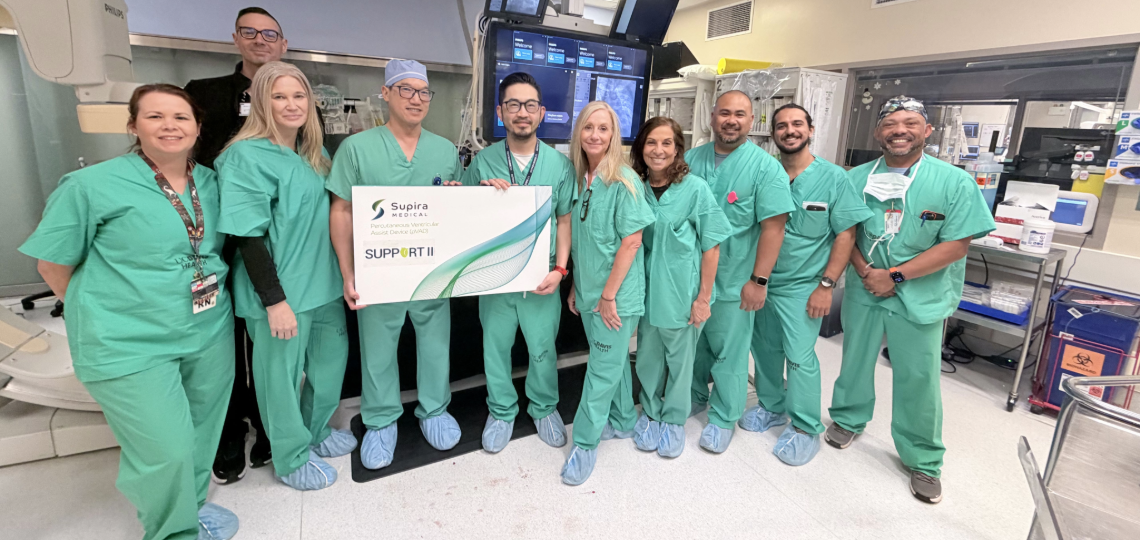
The SUPPORT II Pivotal Study is assessing the investigational Supira System, a low-profile percutaneous ventricular assist device (pVAD) that provides temporary hemodynamic support during high-risk percutaneous coronary intervention.
The trial will enroll up to 385 patients across as many as 40 sites in the United States to evaluate the safety and effectiveness of the system. Patients are randomized to the investigational pVAD system or a larger commercially available pVAD system.
“We are excited to participate in this clinical trial and contribute to advancing care for some of our highest-risk cardiovascular patients,” said Garrett Wong, clinical professor of cardiovascular medicine and co-principal investigator of the study. “This trial enables us to offer a procedure to patients who would otherwise be considered too high risk.”
What is a pVAD system?
Cardiologists use pVADs during stent placement or angioplasty procedures to support blood flow for high-risk patients with severe coronary artery disease or comorbidities.
Additionally, pVADs are used to treat patients suffering from cardiogenic shock, a condition that can occur following a severe heart attack. The condition is linked to a high rate of morbidity as a patient’s heart is suddenly too weak to adequately pump blood to vital organs.
The device in this clinical trial is smaller than current devices. The system includes multiple sensors to collect real-time aortic and ventricular pressures and help guide clinical management.
“Achieving high flow rates has traditionally required larger devices, which can present challenges with both vascular access and positioning,” said Tai Pham, assistant professor of cardiovascular medicine and co-principal investigator of the study. “This investigational system’s low-profile design aims to reduce the risk of vascular complications associated with larger commercial devices while still providing full hemodynamic support during high-risk coronary interventions.”